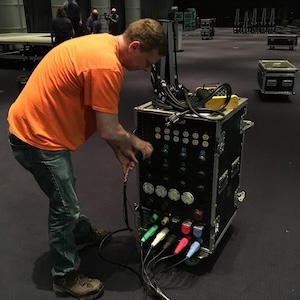
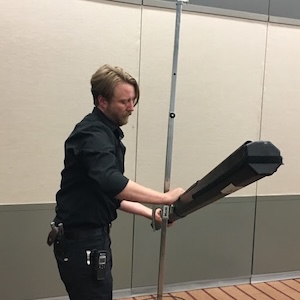

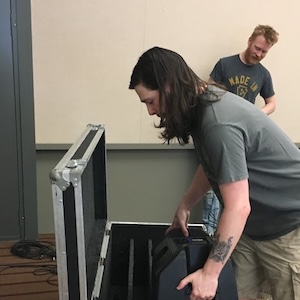
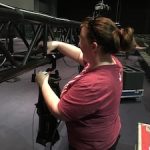

Do these workplaces look familiar to you?
Is this the kind of environment you work in day to day?
Would you like a voice in your working conditions?
Welcome
Welcome to the Audio Visual Technicians organizing website. The International Brotherhood of Electrical Workers (IBEW) Local Union #5 has created it to communicate with Audio Visual Technicians, answer any questions you may have about unions, and form one in your workplace.
Why was this website created? This website was created because the IBEW believes that employees should have a voice in their working conditions, compensation, and benefits. It is purely for informational purposes, so employees have a place to get the information they were seeking and make an informed decision about whether or not they’d like to join together with coworkers and bargain collectively with their employer for a written collective bargaining agreement.
ONE UNITED VOICE
Join us and enjoy higher pay, more secure benefits, access to better healthcare, better job security, and a career you can depend on. As an IBEW member, you will be able to provide for yourself and your family, build a career to last, and do work for which you can be proud.
Frequently Asked Questions
Workers in the United States have a law that gives them the right to join or form unions if they so choose, and it’s unlawful for an employer to threaten, coerce, or retaliate against any employee who chooses to exercise those rights. It’s called the National Labor Relations Act (NLRA), and it was passed in 1935.
- Under the NLRA, employees have a right to engage in concerted activities with co-workers for mutual aid and protection. They can discuss workplace issues with each other such as pay rates, benefits, how they’re being treated by management, etc. Any retaliation by an employer against employees because they’re engaging in this type of activity violates federal law.2
- How do we determine if a majority of the workers in our bargaining unit want to form a union and negotiate collectively with ComcastCable for a written contract? The National Labor Relations Board, the federal government agency that oversees this law, comes in and holds a secret ballot election.
-
- If the majority of the workers vote YES, the NLRB certifies the union as the workers’ collective bargaining representative. At this point, the employer can no longer make unilateral changes to the current terms and conditions of employment and must maintain the “status quo” while negotiating with the employees for a written contract.
-
- If the majority of the workers vote NO, the union is not certified as the employees’ collective bargaining representative and all remain “at-will employees.”
- First, it’s important to again recognize that you and your co-workers are forming this union. Using your union to harm the employer would obviously not be in your best interest and is therefore not something you would do.
- Second, the IBEW is by no means anti-employer. It fully recognizes that employers and employees are co-dependent on each other, and when companies prosper it provides opportunities for workers to prosper too.
- When employees form unions and engage in collective bargaining, they’re doing so to protect their interests and help assure they’re not trampled on as their employers seek to increase profits.
- Union dues are voted on by the union’s members and appear in the IBEW’s Constitution and the local union’s By-Laws. Dues to the International Union are voted on by delegates IBEW local unions send to its International Convention held every 5-years. Dues for IBEW local unions are voted on and established by the members of that local and are listed in its By-Laws.
- The Executive Board of IBEW has approved a dues structure for Comcast a change to the current By-Laws that the Comcast Cable employees would need to vote on and pass once they become members.
- Further, workers in IBEW organizing campaigns don’t pay any dues whatsoever until the election is won, a first contract has been negotiated, and that contract has been voted on and accepted by a majority of the employees in the bargaining unit.
- The IBEW also waives initiation fees for new members joining the union as a result of an organizing campaign.
No, there won’t be any strikes unless you and the majority of your coworkers want one. I suspect you don’t and can certainly understand why. Strikes are extremely rare in the IBEW because the risk and costs almost always outweigh the potential gains. The IBEW does not advocate strikes and never orders workers to strike.
Don’t allow this common employer scare tactic to keep you from supporting your union.
- The NLRB requires that employees demonstrate a minimum showing of interest before it will come in and conduct an election. It requires proof that at least 30% of the workforce is interested in collective bargaining.
- As such, the union must first determine what it feels is an appropriate bargaining unit. In a cable facility, that would likely be all the maintenance and installation techs.
- The IBEW then asks employees in this bargaining unit to sign an “Authorization Card.” These cards are used for two purposes. (1) They show IBEW who supports forming a union. (2) They show the NLRB there’s a sufficient number of interested employees for them to hold an election.
- Can I be fired for signing a card? It is clearly unlawful for an employer to retaliate against anyone for signing a card. Additionally, these cards are treated as strictly confidential by the IBEW and the NLRB. (Unless you tell someone you signed one, no one will ever know.) Cards can be submitted electronically from this website, further assuring confidentiality.
- Can I sign a card and still vote NO? Yes, the cards only get you to an election. It’s the votes cast during that election that determines if the majority support the union and collective bargaining.
- If enough employees sign authorization cards, IBEW will file a petition with the NLRB that asks them to come in and hold a secret ballot election.
- On this petition, the union lists the employer and location, and a description of the bargaining unit. Not the names of the employees, but a list of classifications to be included, as well as those to be excluded. (Managers, supervisors, and security guards are automatically excluded by law.)
- The employer receives a copy of the petition, but not the authorization cards. They go directly to the NLRB who also won’t reveal who signed them, or even how many employees signed them.
- The NLRB will try to get the union and the employer to mutually agree to the election details and bargaining unit. This happens 90% of the time, and when it does the parties sign a stipulated election agreement outlining the bargaining unit, and when and where the election will be held.
- Sometimes an employer will challenge the make-up of the bargaining unit. (It has the right to make a challenge, but it can’t dictate what it will be.) If Comcast Cable were to challenge the make-up of the petitioned-for unit, the NLRB listens to the arguments from both sides and makes the final determination of who is included and who is excluded, and when and where the election will be held.
- The amount of time between the union filing the petition and the actual election, is typically three to four weeks. The process may be delayed if the employer challenges the petitioned-for bargaining unit, and some employers use challenges as a delay tactic
- Some employers respect their employees’ right to choose to form a union and negotiating collectively, or remaining at-will employees.
- There are some employers who prefer this relationship, as it stabilizes the workforce, helps it retain experienced and valuable workers, and helps them to project their labor costs in the coming years.
- That being said, employers do tend to prefer the “At-Will” employment relationship because it allows them to call all the shots unilaterally. It allows them to make changes anytime it wants or for whatever reason. Having their employees take advantage of the National Labor Relations Act creates an unwanted counter to management’s ultimate power, so you can at least expect Comcast Cable to try to persuade you that your better off being union-free and campaign against the union.
1. Most employers who learn that their employees are forming a union will bring in their own specialists. They may call themselves union avoidance consultants, or labor relations consultants, but their job is to convince you to remain at-will employees. These well-paid consultants orchestrate and carry out the employer’s campaign against the union.
2. The management will likely hold captive audience meetings to talk to employees about unions and how bad it would be if one were to come into this workplace. High-level managers and corporate executives often speak at these meetings too. The meetings are held during the workday, so attendance is mandatory. They often include lunch or a pizza party.
3. The goal of the union buster is to create fear and doubt among the employees.
a. They’ll ignore the fact that you and your coworkers are forming this union and portray the union as “a third-party of outsiders” coming in to disrupt the great relationship that currently exists.
b. They’ll portray the union as a business, saying you’re just customers that the union needs to stay in business. They’ll ask, “Why would want to pay money to a union?
c. They’ll admit they may have made some mistakes and weren’t aware that employees weren’t happy. This is followed up with the promise to make things better if you give them one more chance.
d. They’ll try to discourage you by saying that organizing will be an act of futility, or that you may end up with less than you have now. (For one, this is an unlawful threat, and two, it’s not true. No contract goes into effect unless it’s voted on and accepted by the workers, and why would you vote to accept a contract that wasn’t beneficial to you?) Click Here for more info on how.. “Bargaining does not start from a blank sheet of paper.”
e. For more things employers say to dissuade employees from forming unions, click on “12 Dirty Tricks You Should Know About.”
4. Because employers need a majority of the employees to vote against the union, you can expect to be treated with the respect you’ve long deserved. This is by design, as it’s a proven tactic to make employees feel things are better now and maybe we don’t need a union after all. (Hint: It goes away as soon as the threat of forming a union goes away, and things go back to the way they had always been.)
a. You should be prepared for lies and false statements made by your employer. The NLRB will not investigate false statements and lies made during an organizing campaign because it feels it’s the workers’ responsibility to distinguish fact from fiction. As such, it is absolutely imperative that you do your own research and determines for yourself who is telling you the truth and who is lying to you.
- The union can’t control how your employer behaves so we can’t promise that it won’t violate the law. However, any threats, coercion, or retaliation by the company will result in the union filing Unfair Labor Practice Charges with the National Labor Relations Board.
- You can learn more about your rights under the National Labor Relations Act by visiting the NLRB’s website: nlrb.gov.
- Here’s 35 things that employers sometimes do that violates the law. “35 Things The Company Can Not DO Flyer.”
- If you’ve decided that you like the idea of forming a union and bargaining collectively for a written contract, you need to convey this to the union because we won’t proceed until we know there’s enough support to win.
- You show that you’re onboard by submitting an Authorization Card. These cards are not shown to the employer and remain confidential. They are used for two purposes, (1) to show the union how many people support organizing, and (2) they show the NLRB that there’s enough support to come in and hold an election. Authorization Cards can be submitted electronically and are accessed here: Electronic Authorization Card Form. If you prefer the more traditional paper card, call or email one of the IBEW Representatives and one will be mailed to you.
- If you’re unsure and want more information, you can contact one of the following IBEW Representatives who can answer your questions. Contact them by phone or email, and your communications will be kept strictly confidential.
Information Library
Authorization Card
What are they? An authorization card is a card signed by an employee signifying his or her desire to form a union.
CLICK HERE
Dirty Dozen
In every union election, companies use tricks to discourage workers from joining together for a voice at work.
CLICK HERE
35 Things
35 things your company cannot do when you are trying to organize a union or during an election campaign.
CLICK HERE
Unions and You
Unions protect the rights and dignity of the individual through the collective efforts of all.
CLICK HERE
Right to Organize
Employees shall have the right to self-organization, to form, join, or assist labor organizations, to bargain collectively.
CLICK HERE
Bargaining
If managers claim that negotiations start from scratch, tell them the Supreme Court disagrees.
CLICK HERE
Have a Question for Jim Ryan?
James Ryan, Business Agent
IBEW Local Union #5
5 Hot Metal St
Suite 400
Pittsburgh, PA 15203
412-432-1445 (O)
412-638-8622 (C)